Friday, April 18, 2014

St George Island Fallout!

April 15th brought an unusually strong cold front barreling through the Florida Panhandle and northern Gulf of Mexico. Strong winds and heavy rains pounded St. George Island for the first half of the day, before finally clearing to a brisk north wind.

These conditions served as a rude arrival for songbirds crossing the Gulf the following night. The sun rose on the 16th to reveal St. George Island covered in recently arrived trans-Gulf migrants, taking advantage of the first bit of land they could rest on. Flocks of buntings flushed off the grassy shoulders, kites and swallows wheeled through the gusty skies, and streams of electric-colored grosbeaks, tanagers, and orioles crossed from tree to tree.

Over the following day and half, we were able to band roughly 150 migrants at our field site in Unit 4 ANERR, and observed 51 species of trans-Gulf migrants, many in astounding numbers.

We were also very excited to have ECSC colleagues visit from Florida A&M University on the 16th, including Dr. Charles Jagoe, Dr. Daniel Osborne, and Ph.D students Mario Marquez and LaTrisha Allen.

Here are some photos that help sum up what was an amazing few days.

As the front cleared on April 15th, the winds intensified and shifted to the northwest, turning Apalachicola Bay into a roiling cauldron. These are very poor flying conditions for a northbound migrant, and for the next few days St. George Island became a haven for these weary, tropical travelers.  
The Swainson's Warbler is an elusive summer denizen of southern forests with dense understory, whether its rhododendron thickets in the Appalachians or canebrakes on the coastal plain. 
The Prothonotary Warbler spends the breeding season in mature, flooded forests of the south. Their name refers to the Chief Secretary of the Chancery at Rome, who wears a yellow robe. It is also nicknamed the Golden Swamp Warbler, and is, without a doubt, one of the brightest of all songbirds. 
We were lucky enough to band a few Painted Buntings, including this adult male.  Wintering in Central America, these jewels breed in two distinct populations, one on the Gulf Coast and one on the south Atlantic coast.
With a massive, powerful beak, we had to guard our fingers from this male  Rose-breasted Grosbeak.
The Blue Grosbeak is another species with a formidable beak, and is a wide-ranging breeding species in open areas throughout the southern tier of the country. 
Not all is peaceful for the migrants on St. George Island! They must remain forever vigilant against predators, including this Merlin. Merlin's are the medium-sized falcon of North America, smaller than the Peregrine but larger than the kestrel. They maraud along the coastlines during the winter, before retreating to the far north to breed.
Dr. Lori Lester (left) demonstrates the process of handling a Rose-breasted Grosbeak to Dr. Charles Jagoe, Dr. Daniel Osborne, and Ph.D student LaTrisha Allen from Florida A&M University. 

Monday, April 14, 2014

The 2014 Season Begins On St. George Island

Today, April 14th, marked our first full day of field work for our Delaware State University crew on St. George Island, Florida this spring. Like last year, we will be operating mist-nets at Unit 4 of the Apalachicola National Estuarine Research Reserve (ANERR) as part of a research effort to evaluate the significance of St. George Island as a stopover site for trans-Gulf Neotropical migrant songbirds.

Using mist-nets allows us to inspect the physical condition of recently arrived birds and better assess their age and sex. While having a bird in hand, we give it a uniquely numbered leg band which will be its calling card if it is ever caught again.

We were excited to hit the ground running, and had a productive morning, joined by Megan Lamb, the ECSC coordinator for ANERR.

Our first bonafide neotropical migrant was this Worm-eating Warbler, a species that winters in Central America and the West Indies. At home in the mid-story of forests, they specialize in probing for morsels in dead leaf clusters. 
Mid-morning we had a noticeable influx of newly arrived trans-Gulf migrants at our field site.  The standouts were two absolutely vivid  male Scarlet Tanagers, perhaps seeing ground for the first time since South America. 
There are more than just songbirds around! This dashing Short-billed Dowitcher was foraging actively in the shallow bayside waters of Unit 4. Before long, this bird will migrate northward to the boreal muskegs for the breeding season. 
Although our research focuses on long-distance migrants, we can't help but admire the beautiful year-round residents of St. George Island. This male Eastern Towhee offered a rare unobstructed view as we scouted our field site out yesterday afternoon. Note the white eye. Towhees in northern states have red eyes. 
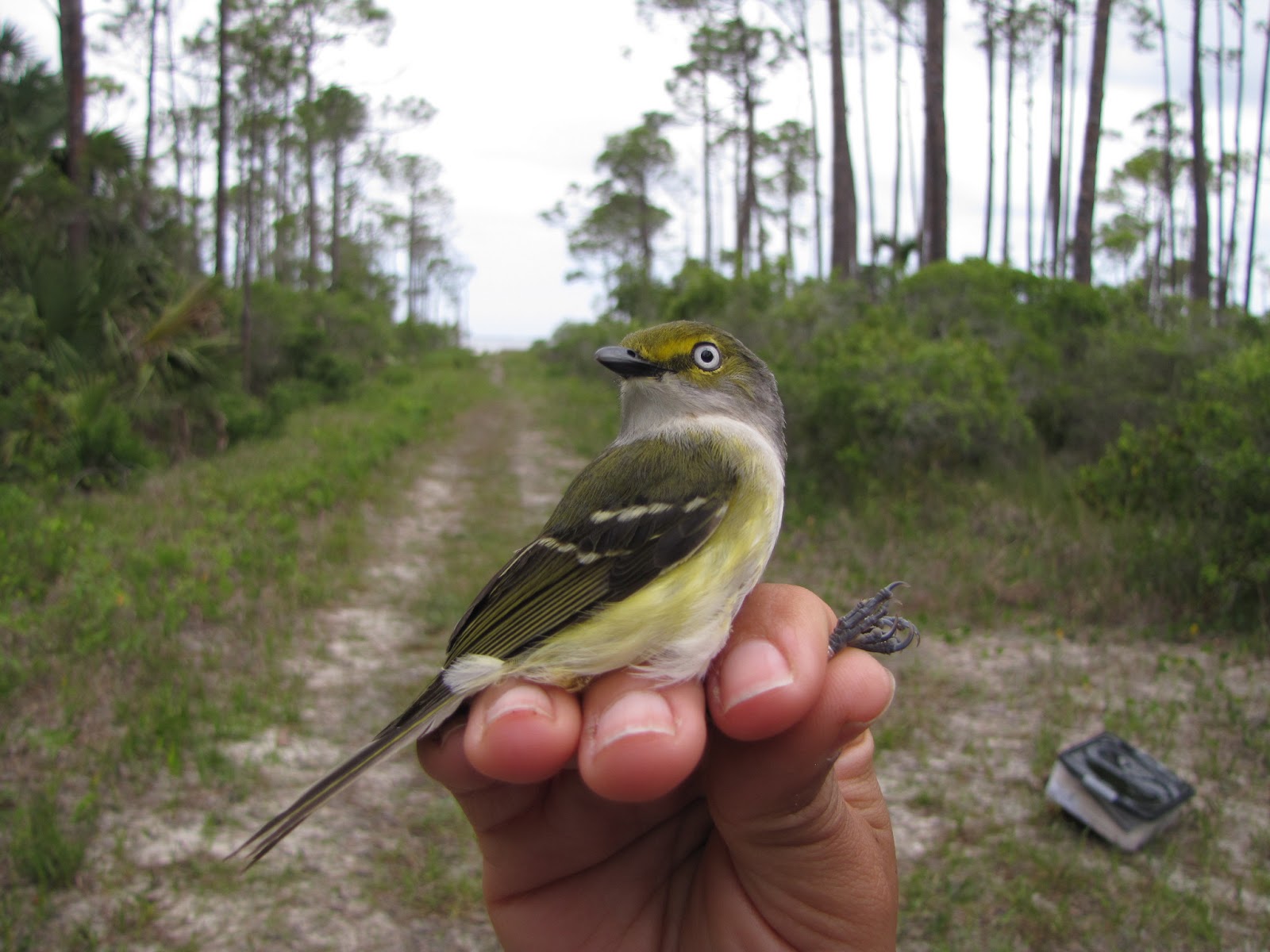
We were excited to recapture one of the resident White-eyed Vireos that we banded last year.  White-eyed Vireos are common breeders in the dense evergreen understory of the pine flatwoods on St. George Island.

Tuesday, May 7, 2013

The Local Sights

The view coming off the bridge into Apalachicola.
A rusted trawler rests in the marshes of the Apalachicola River delta.
Storms roll in over Apalachicola Bay as we cross the bridge onto St. George Island. When a trans-Gulf migrant approaches the coast and encounters stormy weather, they often take aim on the first land they see. Here, that first bit of land is St. George Island.
The view along Gulf Beach Drive, St. George Island. The open areas are utilized by migrant Bobolinks, as well as a host of adaptable residents such as Gray Kingbirds, Northern Mockingbirds, and Common Ground-Doves.
Beyond the rows of beach houses lie remnant tracts of pine flatwoods. It is in these woods that migrating birds congregate. This pond is in the middle of our plot in Unit 4 of the Apalachicola National Estuarine Research Reserve (ANERR). Local Green Herons are often seen along the perimeter, and at dusk begins a ringing chorus of frogs and toads.
The sun sets over Apalachicola Bay and the Bryant Patton Bridge. Numerous migrant shorebirds feed along the bay shore, while terns from nearby breeding colonies hunt overhead. The bay is also a hotbed for oyster harvesting, helping make Apalachicola one of the oyster capitals of the country.

Monday, May 6, 2013

Vireos: It's All In The Eyes

Vireos are a New World family of birds that are characterized by their deliberate feeding methods and hooked bills. Two of the most likely vireo species to be encountered on St. George Island are the White-eyed Vireo (Vireo griseus) and Red-eyed Vireo (Vireo olivaceus).

As you might expect, the eye color is a good clue for identifying these birds. The eye is also a clue for the bird's age, as neither species gains their namesake color until they are nearly a year old.

The Red-eyed Vireo, seen below, is found in almost any sizable patch of broadleaf forest in eastern North America. It's sweet, monotonous "here i am, where are you" song is given throughout the day from high in the canopy, even on the hottest summer afternoons. They winter predominately in South America. Over the past few days we have begun to catch migrating Red-eyes on St. George Island, as well as pick them up on our transects.


The White-eyed Vireo, seen below, breeds at our study site on St. George Island. Throughout their breeding range in the Southeast, they prefer dense, impenetrable thickets. Often the only clue to their presence is their explosive, unmistakable song, "chick, poweeo, chick." We have banded several of the locals, as well as possibly a few migrants returning from Central America.


Saturday, May 4, 2013

Boiled Peanuts


A dog rests while his owner stops for boiled peanuts in Eastpoint, Florida. We tried a round of cajun boiled peanuts ourselves - the jury is still out.

Friday, May 3, 2013

An Influx of Thrushes

Thrushes of the genus Catharus range throughout the Americas. The genus is characterized by generally cryptic plumage, which they make up for with their ethereal, fluted songs. Crepuscular denizens of the undergrowth, thrushes often go unseen to the casual observer.

Their annual migrations cover up to 6,500 km, traversing between their breeding grounds in North America and their wintering grounds in Central and South America.

As Spring trans-Gulf migrants, thrushes are dependent on finding stopover sites that provide shelter and refueling opportunities as they return to their breeding grounds. Quality stopover sites along the Gulf Coast are of particular importance to three Catharus species: Veery (Catharus fuscescens), Gray-cheeked Thrush (Catharus minimus), and Swainson's Thrush (Catharus ustulatus).

We are in the midst of the peak migration period for these birds here on St. George Island. Over the past few days we have captured our first individuals of each species. Learning to identify these thrushes takes practice, but with care there are certain unique characteristics you can clue in on.


The Veery's preferred breeding habitat is broad-leaf forest, and is best identified by its uniformly reddish coloration.


The Swainson's Thrush is found from coast to coast in North America and shows off distinctive buffy spectacles and upper breast.


The Gray-cheeked Thrush breeds in the boreal forests of Canada and is best identified by its cold, gray coloration and lack of an eye ring.

Thursday, May 2, 2013

Brilliance

Birds capture our imagination because they can fly, they can sing, and because they are beautiful. Some birds in particular are capable of reawakening our childlike enthusiasm, leaving us speechless and in awe.

One of these moments happened today, when we were treated with one of the most spectacular of all North American birds, a Scarlet Tanager (Piranga olivacea). Although we had detected this species multiple times on transects through our study site, we had not captured one. Finally, our dreams came true.


This particular bird is a second-year male. If you look closely, you can see the molt-limit on his wing, where the more worn, dull gray primary coverts contrast with the fresher, velvety black of the greater, median, and lesser coverts. Wintering primarily in South America, in summer the Scarlet Tanager brings its tropical brilliance to broadleaf forests across eastern North America. 

Closer inspection revealed that he had burned all of his fat reserves and had begun to catabolize his breast muscle. In order to continue his journey northward and successfully breed, he will have to regain much of what he has lost. Whether he does that here on St. George Island is one of the questions we are here to answer.